Odoo security advisory Nov 2026: CVE-2026-130028 and 130029
Odotify team · Published · 7 min read
On 23 November 2026 Odoo S.A. sent its Enterprise customers and partners security advisory ODOO-SA-2026-11-23. It covers two flaws rated high severity, in both Community and Enterprise, and it comes with a warning Odoo rarely writes: the flaws are already being exploited against self-hosted servers, including by automated AI agents. This article is for anyone who runs Odoo on their own server or relies on someone who does. It sets out what is affected, what to do today, and how this applies to instances hosted on Odotify. Everything below comes from Odoo's advisory email and pages we read on 24 November 2026; where Odoo has not published a detail, we say so instead of guessing.
What is in the ODOO-SA-2026-11-23 advisory?
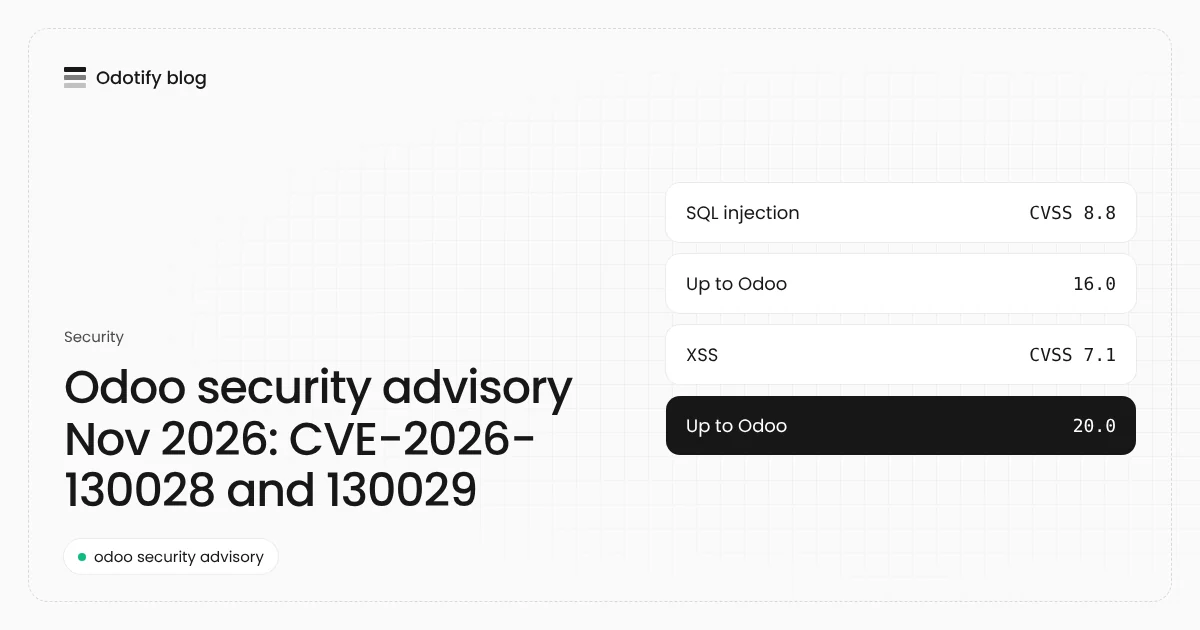
Two vulnerabilities, both in Community and Enterprise editions:
| CVE | Type | Affects | Severity (CVSS 3.1) |
|---|---|---|---|
| CVE-2026-130028 | SQL injection | Odoo 16.0 and earlier | High, 8.8 |
| CVE-2026-130029 | Cross-site scripting (XSS) | Odoo 20.0 and earlier | High, 7.1 |
Odoo's summary adds two points that change how fast you should act:
- Active exploitation. Odoo says it has been notified of attacks exploiting these flaws "in the wild against on-premise deployments running affected versions, including attacks carried out by automated adversarial AI agents".
- Odoo's own cloud is patched. All official Odoo Cloud services (Odoo Online and Odoo.sh) already have the patches. Odoo.sh projects on a "pinned revision" should move to the latest official revision; Odoo says this should be done automatically.
In other words, the remaining exposed systems are the self-hosted ones.
CVE-2026-130028: SQL injection in Odoo 16.0 and earlier
Odoo's description: a SQL injection in Odoo Community 16.0 and earlier and Odoo Enterprise 16.0 and earlier "allows an authenticated user with read access to an affected model to execute SQL with the application's database privileges, enabling unauthorized access to and modification of database data".
What that means in practice:
- The attacker needs an account, but not a powerful one. Read access to an affected model is enough. Odoo has not published which models are affected. Any internal user could qualify, and on databases with a customer portal, portal users may too.
- The impact is the whole database. "The application's database privileges" are the rights of the PostgreSQL role Odoo connects with. That role normally owns every table, so the attacker can read and change data far beyond what their Odoo access rights allow: invoices, bank details, salaries, password hashes.
- The CVSS vector says the same thing: network attack, low complexity, low privileges, no user interaction, high impact on confidentiality, integrity and availability (
AV:N/AC:L/PR:L/UI:N/S:U/C:H/I:H/A:H).
How the patch is delivered: Odoo says only non-LTS versions are affected, "so patches are provided in the full advisory, rather than via updated installers". If you run 16.0 or older, waiting for a new package will not fix this. You need the patch from the full advisory, or a move to a newer version.
CVE-2026-130029: XSS in Odoo 20.0 and earlier
Odoo's description: a cross-site scripting issue in Odoo Community and Enterprise 20.0 and earlier "allows a remote attacker to execute script in another user's browser when attacker-supplied content is displayed".
- Every version is affected, up to and including the current Odoo 20.0. Being on a recent version does not protect you; only patched code does.
- No account needed. The CVSS vector (
AV:N/AC:L/PR:N/UI:R/S:U/C:L/I:H/A:N) says the attacker needs no privileges, but a user has to open the content the attacker supplied. In an ERP that receives emails, chatter messages, website forms and documents from outside, that is not a high bar. - The impact is on integrity: a script running in a logged-in user's browser can act with that user's rights. If the victim is an administrator, so is the script.
Is my Odoo affected?
Use this table. "Self-hosted" means any server you or your provider run, including Docker, a VPS or a server in your office.
| Where your Odoo runs | Version | CVE-2026-130028 (SQLi) | CVE-2026-130029 (XSS) |
|---|---|---|---|
| Odoo Online | any | Patched by Odoo | Patched by Odoo |
| Odoo.sh | any | Patched; update a pinned revision | Patched; update a pinned revision |
| Self-hosted | 16.0 or older | Affected | Affected |
| Self-hosted | 17.0, 18.0, 19.0, 20.0 | Not affected | Affected until patched |
To check the version of a self-hosted server, open Settings and scroll to the bottom of the page, or run odoo --version (or odoo-bin --version) on the server.
Steps to protect a self-hosted Odoo server now
- Read the full advisory. Odoo's email says the remediation "may require more than updating Odoo". The full text for each CVE is at
odoo.com/security-advisories/CVE-2026-130028.txtandCVE-2026-130029.txt. On 24 November those links required an active Enterprise subscription code, because Odoo gives Enterprise customers early access before public disclosure. If you have no subscription, ask your Odoo partner or hosting provider. - Back up first. Take a database dump and a copy of the filestore, and copy them off the server. Our Odoo backup and restore guide has the commands.
- Patch. On 17.0 to 20.0, update your Odoo code (packages, Docker image or source checkout) to a build that includes the fix, then restart Odoo. On 16.0 or older, apply the patch from the full advisory, then plan an upgrade: older versions will keep getting fixes only this way, if at all. Our Odoo upgrade guide explains the steps.
- Shrink who can log in. The SQL injection needs an account. Archive users who left, remove portal access nobody uses, rotate passwords that may have been shared, and turn on two-factor authentication for internal users.
- Close what scanners look for. Set
list_db = False, keep the database manager off the internet, put Odoo behind HTTPS with rate limits on/web/login. Our 15-point Odoo security checklist walks through each setting. - Look for signs of abuse. Odoo has not published indicators of compromise. Until it does, review Odoo and proxy logs for the last weeks: database errors in the Odoo log, unusual volumes of requests from one address, new or changed administrator users, and changes to bank accounts or payment details.
If you suspect a breach that touched personal data, your data protection obligations apply (under GDPR, notification within 72 hours of becoming aware of it).
How are Odotify-hosted instances affected?
Odotify is our product, so here is exactly where it stands, based on how the platform works today:
- CVE-2026-130028 does not apply to instances run by Odotify. Odotify runs Odoo 17.0, 18.0, 19.0 and 20.0 only; it does not create or import instances on 16.0 or older.
- CVE-2026-130029 is patched on Odotify. It reaches up to 20.0, so it concerned every version Odotify runs. Odotify's Odoo images are built from Odoo's official source branches, and they have already been updated to the latest patched versions. Enterprise instances also run Enterprise code from the package uploaded to Odotify, so keep that package on Odoo's latest release.
- The firewall in front of every instance is not a fix, but it reduces the automated scanning these attacks rely on: it blocks known scanner paths and attack tools, limits sign-in attempts, can block Odoo's database manager (a rule you switch on in the Firewall settings) and bans addresses that keep tripping those rules.
What you can do today on Odotify: review your users and portal access (step 4 above), make sure two-factor authentication is on for internal users, and take a manual backup whenever you want a restore point.
FAQ
What is ODOO-SA-2026-11-23?
It is the security advisory Odoo S.A. sent on 23 November 2026 to Enterprise customers and partners. It covers CVE-2026-130028, a SQL injection in Odoo 16.0 and earlier, and CVE-2026-130029, a cross-site scripting flaw in Odoo 20.0 and earlier, both rated high severity.
Is Odoo Online or Odoo.sh affected?
No. Odoo says all its official cloud services already have the patches. Odoo.sh projects on a pinned revision should update to the latest official revision, which Odoo says should happen automatically.
Is Odoo Community affected, or only Enterprise?
Both. The advisory lists Community and Enterprise for each CVE.
I run Odoo 17.0 or later. Do I need to do anything?
Yes. You are not affected by the SQL injection, but the XSS reaches every version up to 20.0. Update your Odoo code to a build that includes the fix.
Why are the patches for 16.0 not in the normal installers?
Odoo says only non-LTS versions are affected by the SQL injection, so it provides the patches in the full advisory instead of new installers. Download them from the advisory, or upgrade to a supported version.
Where can I read the full advisory?
On odoo.com/security-advisories. Upcoming advisories are reserved for Enterprise customers with an active subscription code until Odoo discloses them publicly.
Sources
- Odoo security advisory email ODOO-SA-2026-11-23, sent to Odoo Enterprise subscribers and partners on 23 November 2026
- Odoo security advisories page (early access for Enterprise customers): https://www.odoo.com/security-advisories
- Sysprovider, an Odoo hosting provider, on the same advisory (in Spanish): https://www.sysprovider.es/blog/vulnerabilidades-odoo-noviembre-2026-parche
- Odoo images on Odotify: supported versions and weekly rebuild, in the Odotify source code (
images/odoo/README.md,.github/workflows/odoo-images.yml)

Odotify team
Odotify hosts Odoo on servers its customers own. This article was researched against live search results and the Odotify codebase.