Is Odoo open source? Community, Enterprise and licences explained
Odotify team · Published · 5 min read
People ask "is Odoo open source?" for different reasons: a CFO wants to know whether it is free, a developer whether they can change the code, a partner whether they can sell modules. The honest answer is "half of it is". This guide explains exactly which parts of Odoo are open source, what each licence allows, and what that means in practice for hosting, customisation and cost. The licence texts quoted here were read in Odoo's official documentation and source repository on 20 November 2026.
Is Odoo really open source?
Odoo Community Edition is open source. Odoo Enterprise Edition is not.
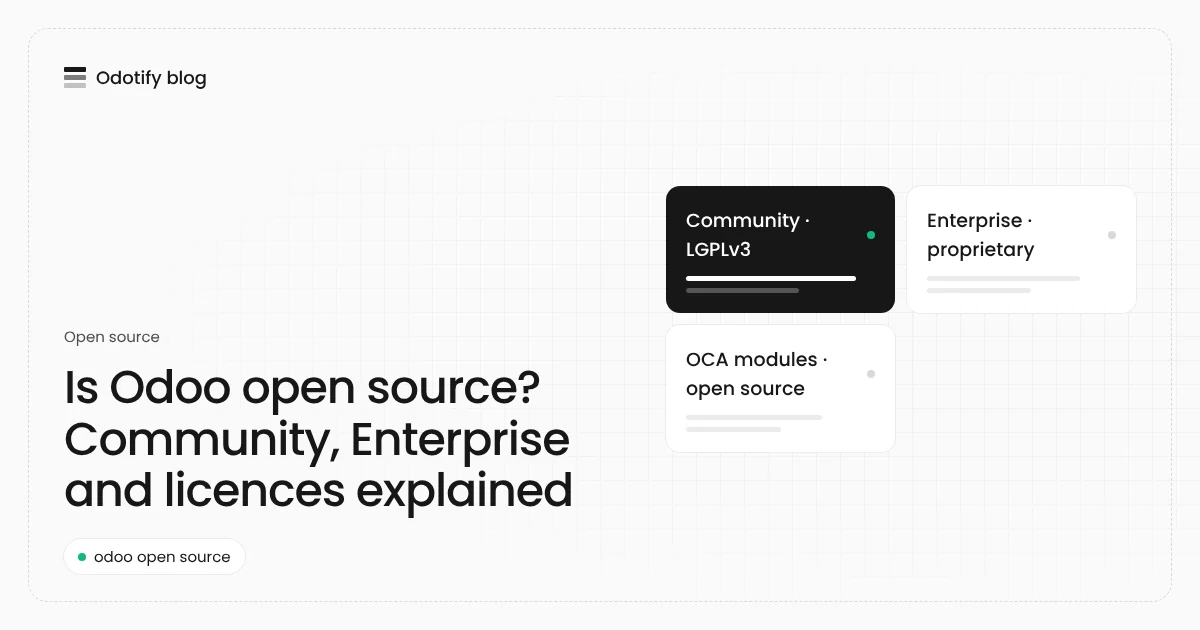
Odoo's legal documentation states it plainly for the current version: "Odoo 19 Community Edition is licensed under LGPL version 3", while "Odoo 19 Enterprise Edition is licensed under the Odoo Enterprise Edition License v1.0". The same pair of licences has applied to every version since Odoo 9. Odoo 8 was different: it was licensed under the AGPL version 3.
The LICENSE file at the top of the public odoo/odoo repository on GitHub repeats it: "Odoo is published under the GNU LESSER GENERAL PUBLIC LICENSE, Version 3 (LGPLv3)".
| Odoo Community | Odoo Enterprise | Odoo Apps by Odoo S.A. | |
|---|---|---|---|
| Licence | LGPL v3 | Odoo Enterprise Edition License v1.0 | Odoo Proprietary License v1.0 |
| Open source | Yes | No | No |
| Source code | Public on GitHub | Provided to subscribers and partners | Provided to buyers |
| Use requires | Nothing | A valid Enterprise subscription for the correct number of users | A purchased licence |
| Redistribution | Allowed under LGPL terms | Forbidden | Forbidden |
What can you do with Odoo Community under the LGPL?
The LGPL v3 is a recognised open-source licence. For Odoo Community it means you can:
- Run it on any server, for any number of users and companies, with no licence fee.
- Read and modify the source code.
- Self-host it on your own hardware or any cloud. See our self-hosted Odoo guide.
- Write your own modules and choose their licence: the LGPL's "lesser" copyleft lets proprietary modules link to the LGPL core.
- Redistribute Odoo Community, including modified versions, as long as you follow the LGPL's conditions for the Community code itself.
What it does not give you: Odoo S.A.'s support, the Enterprise apps, the official upgrade service for Community databases, or hosting. Those cost money, either from Odoo or from someone else.
What does the Odoo Enterprise licence allow?
The Odoo Enterprise Edition License v1.0 is short. Its key terms:
- The software "can only be used (executed, modified, executed after modifications) with a valid Odoo Enterprise Subscription for the correct number of users."
- Partners with a valid Partnership Agreement may use it in testing or development environments.
- You may develop modules based on it and distribute them under a compatible licence (for example LGPL, MIT or proprietary).
- "It is forbidden to publish, distribute, sublicense, or sell copies of the Software or modified copies of the Software."
So you can modify Enterprise and run it on your own server, but only while you pay the per-user subscription, and you cannot share it. That is why Enterprise is not open source even though subscribers get its source code. Our page on Odoo Community vs Enterprise compares the apps in each edition.
Can I get Odoo for free?
Yes, in two ways:
- Odoo Community, self-hosted. No licence cost at any size. You pay for a server and for whoever runs it. Our Odoo pricing guide has a calculator for the total.
- Odoo's "One App Free" plan. Odoo's pricing page offers one app free for unlimited users on Odoo Online (plus any apps that app requires). It is hosted Enterprise software, not open source: the code is not yours to take elsewhere.
What is never free is someone's time: installing, updating, backing up and upgrading Odoo is work whichever edition you run.
What is the Odoo Community Association (OCA)?
The OCA is an independent non-profit organisation based in Switzerland that maintains open-source Odoo modules. Its website lists more than 20,000 modules, 1,600 contributors and 664 members, and states that all OCA projects are available under OSI-certified open-source licences. Many fill gaps between Community and Enterprise: accounting reports, bank statement imports, helpdesk, and more.
The OCA also maintains OpenUpgrade, the open-source tool to upgrade Odoo Community databases from one major version to the next (Odoo's own upgrade service is for Enterprise). The OpenUpgrade repository itself is licensed under the AGPL-3.0, with each module carrying its own licence in its manifest.
Is Odoo "open core"?
Yes. Odoo is a classic open-core product: a complete, usable open-source core (Community) and a paid layer on top (Enterprise) that adds apps such as Studio, full accounting with bank synchronisation, payroll, helpdesk and the mobile apps, plus support, hosting options and upgrades. Enterprise is installed on top of the same Community code: Odoo's guide to switching from Community to Enterprise is back up the database, install the web_enterprise module and enter a subscription code, so your data stays.
Is open-source Odoo safe to use in production?
Yes, thousands of companies run Community in production. The code is public, so problems are found and fixed in the open, and the framework has the same built-in protections as Enterprise. The risk is in how it is run: an unpatched server, an open database manager or no off-site backups. Our Odoo security checklist covers the settings to check.
Running open-source Odoo without running servers
The usual trade-off with open source is "free licence, but you operate it". Odotify narrows that gap: it installs Odoo Community or Enterprise (versions 17 to 20) on a server you own, at Hetzner, DigitalOcean, AWS, Google Cloud, Azure, Vultr or Akamai, or on any Linux server you attach, and then handles HTTPS, updates, backups, restore drills, monitoring and upgrades. You keep root access and your code stays yours. Plans start at $0 a month; see pricing.
FAQ
Is Odoo free for commercial use?
Odoo Community is: the LGPL v3 allows commercial use with no licence fee and no user limit. Odoo Enterprise requires a paid subscription per user.
Is Odoo Enterprise source code available?
To subscribers and partners, yes, but under the Odoo Enterprise Edition License, which forbids publishing or redistributing it. It is not on the public GitHub repository.
Can I sell my own Odoo modules?
Yes. Both the LGPL and the Enterprise licence let you write modules and distribute them under a compatible licence of your choice, including proprietary ones, for example on the Odoo Apps store.
Where is Odoo's source code?
Odoo Community's code is public in the odoo/odoo repository on GitHub, with one branch per version (17.0, 18.0, 19.0, 20.0). Enterprise code lives in a private repository that subscribers and partners can access.
Has Odoo's licence changed over time?
Yes. Odoo's documentation lists Odoo 8 under the AGPL v3. Since Odoo 9, Community is LGPL v3 and Enterprise uses the Odoo Enterprise Edition License.
Sources
- Odoo documentation, Licenses: https://raw.githubusercontent.com/odoo/documentation/19.0/content/legal/licenses.rst
- Odoo Enterprise Edition License v1.0: https://raw.githubusercontent.com/odoo/documentation/19.0/content/legal/licenses/enterprise_license.txt
- Odoo source code licence (LGPLv3): https://raw.githubusercontent.com/odoo/odoo/19.0/LICENSE
- Odoo documentation, Switch from Community to Enterprise: https://raw.githubusercontent.com/odoo/documentation/19.0/content/administration/on_premise/community_to_enterprise.rst
- Odoo pricing (One App Free): https://www.odoo.com/pricing
- Odoo Community Association: https://odoo-community.org/
- OCA OpenUpgrade: https://github.com/OCA/OpenUpgrade

Odotify team
Odotify hosts Odoo on servers its customers own. This article was researched against live search results and the Odotify codebase.